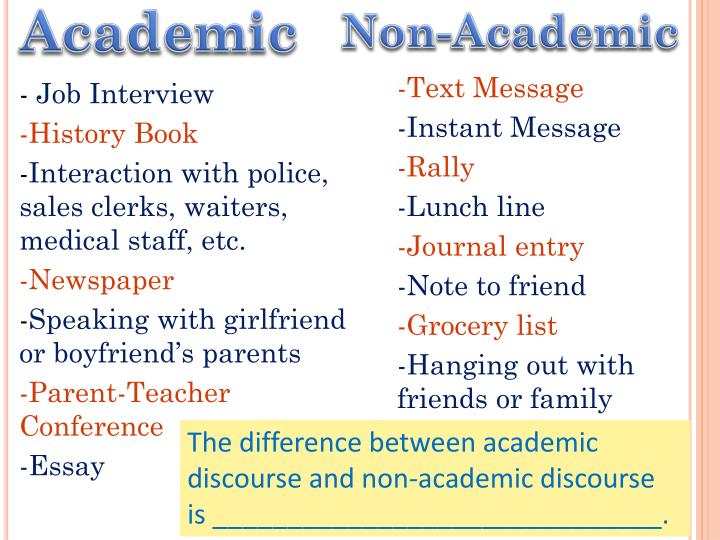
In the article, “Reflections of Academic Discourse: How It Relates to Freshman and Colleagues,” Peter Elbow explains his definition of academic discourse which is using a certain language to continue and engage in a high-level conversation. He believes students need to learn both academic discourse and nonacademic discourse for college and after college. He states how most students whose majors only require two English classes should not have to be forced to use academic discourse because after they graduate, most jobs have their own version of writing that is required for that position and it is not academic discourse. Elbow is not trying to create arguments against academic discourse, but he believes if they were able to allow students a broad range of writings and write informal essays, it will teach students both academic discourse and nonacademic discourse that will be beneficial for life after college. Elbow assumes that employers get upset with students who are fresh out of college because they do not know how to use academic discourse correctly and believes that in order for it to change, it has to start with learning it in college specifically in freshman writing courses.
While I was reading the article, I was confused on what the author was referring to when he said “academic discourse.” I had to google the definition before I was able to continue reading, but even then I was still confused about it. I have never heard of “academic discourse” so I am not familiar with what its point is, but based off google’s definition, I believe it is a form of advance nonacademic communication. The reading was a bit difficult for me to fully understand but what I captured from the nonacademic is that he does not think academic discourse is just one specific thing, but instead cumulative of a variety of writing, forms of communicating, and expressions. I think teaching college students both academic discourse and nonacademic discourse should start within freshman writing courses so students can get used to it from the very start which makes it easier to adapt to it and will stick with students after they graduate. Elbow believes if they were to focus a little more on nonacademic writing and a little less on academic discipline, it will be useful for students. I agree with him because not every company or business that students will work in will require academic discourse. It all depends on the job and position you are placed in but there will be some students who will need to learn this academic discipline for their future jobs. The author talks about his goal is being to protect his students and himself from teaching and focusing on a specific form of writing so in the future the student does not fail the class due to only knowing one form of writing. I am able to relate to this because in high school there was only one form of writing all English teachers would follow which made it difficult for me to let go of when I started to take college classes over the summer. It is good that Elbow can see how beneficial learning the two types of courses will help students in the future.


 Melissa's Blog